Selection & Interfaces
Core product selection criteria, interface logic diagrams, and comprehensive product function tables for all major components of the smart campus environmental monitoring system.
5.1 Core Product Overview
The smart campus environmental monitoring system comprises six core product categories, each serving a distinct function in the measurement and data acquisition chain. Selecting the right product for each category requires understanding the measurement principle, environmental conditions, maintenance requirements, and interface compatibility. The following overview presents the complete product lineup with representative examples of each category.
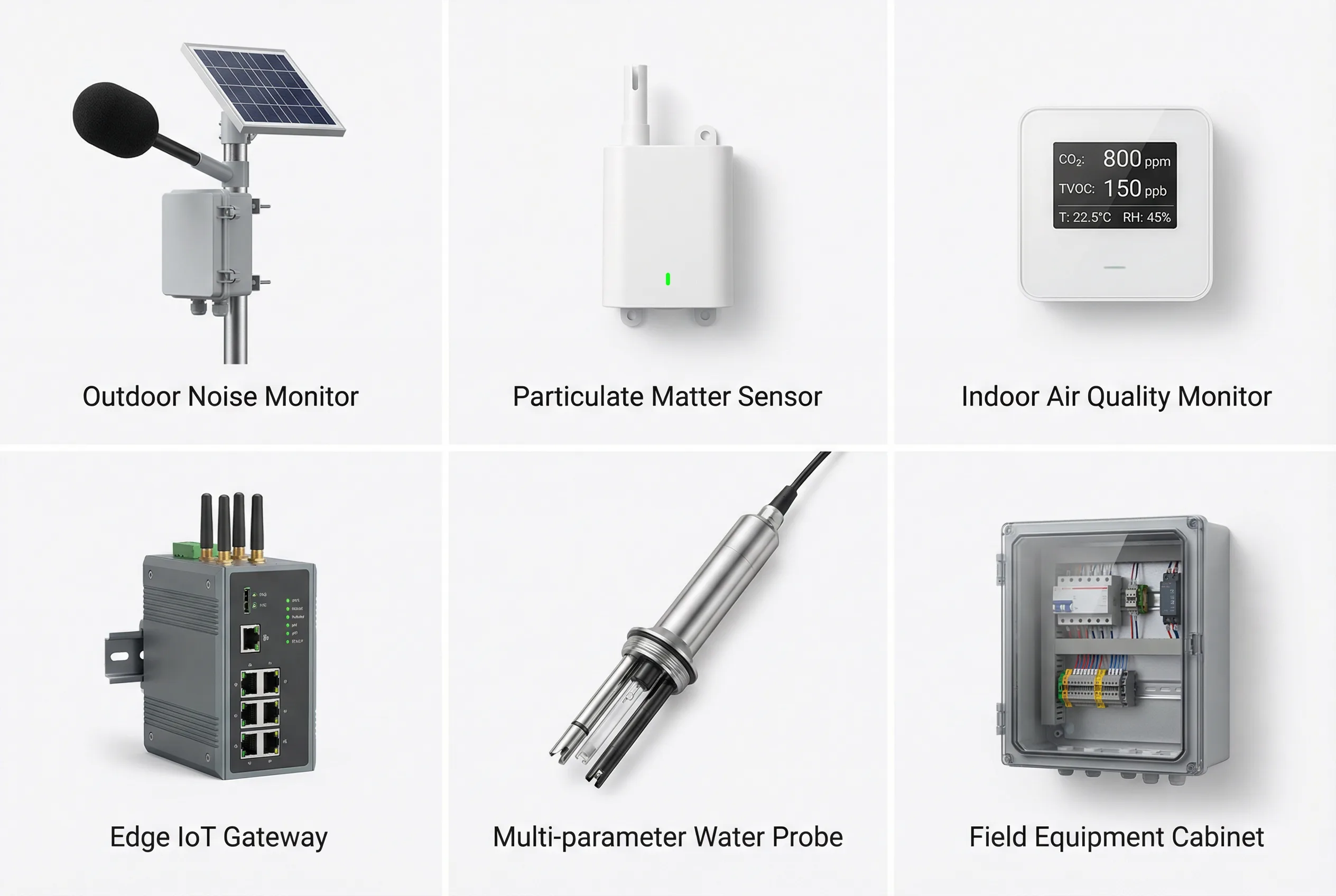
Figure 5.1: Core Product Lineup — Outdoor Noise Monitor, PM Sensor, Indoor Air Quality Monitor, Edge IoT Gateway, Multi-parameter Water Probe, Field Equipment Cabinet
| Product Category | Primary Function | Interface | Power | IP Rating | Typical Lifespan |
|---|---|---|---|---|---|
| Outdoor Noise Monitor | Leq/Lmax measurement at boundary | RS485 Modbus RTU | 12–24V DC or solar | IP65 | 5–8 years |
| Particulate Matter Sensor | PM1/PM2.5/PM10 mass concentration | RS485 or LoRaWAN | 5–12V DC or battery | IP65 | 3–5 years |
| Indoor Air Quality Monitor | CO₂, TVOC, PM2.5, T, RH | RS485, PoE, Wi-Fi | PoE or 5V USB | IP20 | 5–7 years |
| Edge IoT Gateway | Protocol translation, buffering, uplink | RS485 ×4, ETH ×3, 4G, Wi-Fi | 12–24V DC | IP65 (outdoor) | 7–10 years |
| Multi-parameter Water Probe | pH, EC, turbidity, DO, temperature | RS485 Modbus or SDI-12 | 12V DC | IP68 | 2–4 years (probe) |
| Field Equipment Cabinet | Protection and integration of field electronics | Cable glands, DIN rail | AC mains input | IP65 | 10–15 years |
5.2 Interface Logic Diagram
The edge gateway serves as the central integration point for all field devices, providing multiple interface types to accommodate the diverse communication protocols used by environmental sensors. The interface logic diagram illustrates the complete connection topology of the edge gateway, showing all input and output ports, their associated protocols, and the external devices connected to each port. Understanding this interface map is essential for system integration planning and troubleshooting.
RS485 Modbus RTU is the dominant wired protocol for outdoor environmental sensors due to its robustness, long cable runs, and multi-drop capability. The edge gateway typically provides four independent RS485 ports, each capable of addressing up to 32 devices on a separate bus. This isolation prevents a fault on one sensor bus from affecting other zones. The 4–20 mA analog input accommodates legacy sensors that predate digital communication standards.
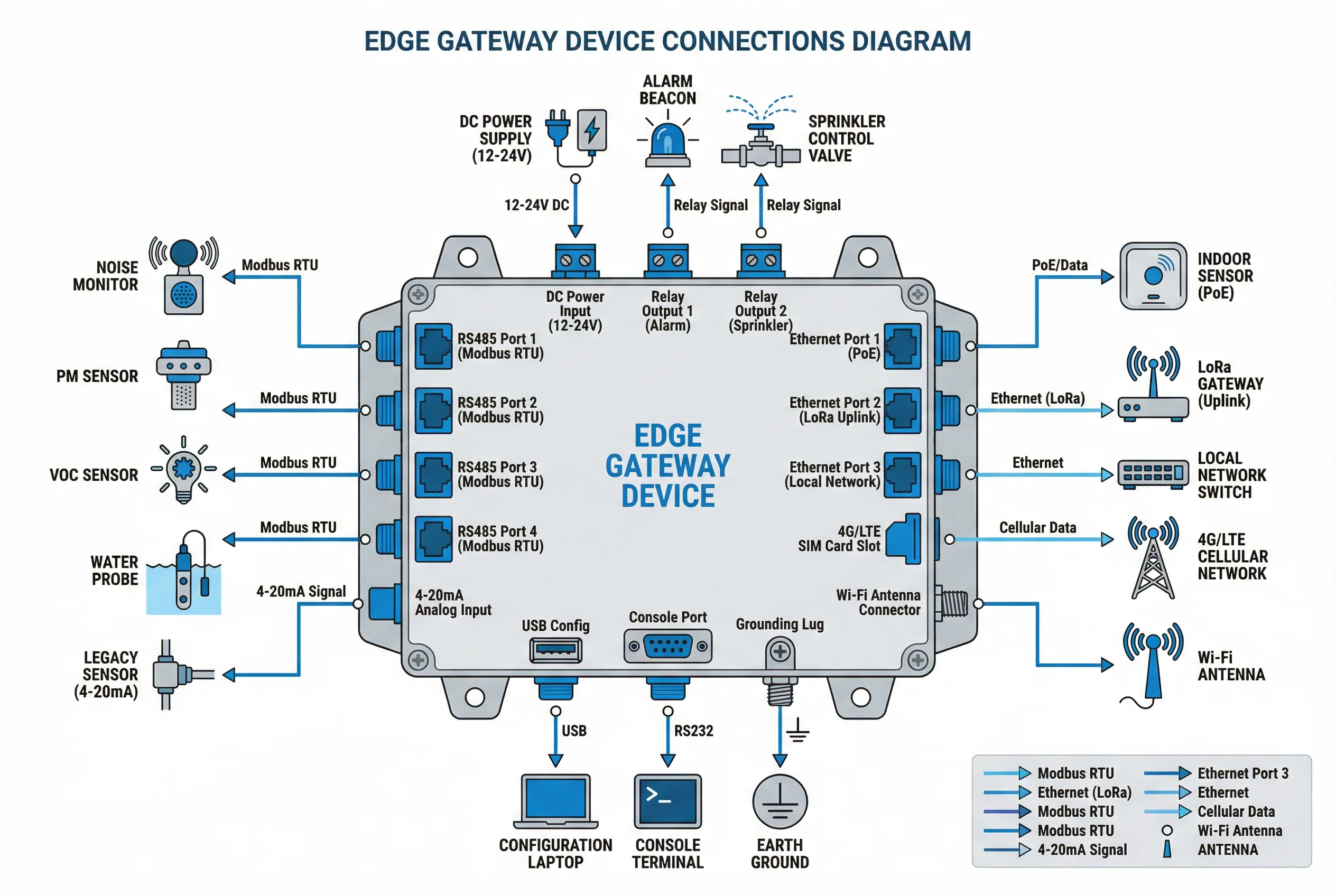
Figure 5.2: Edge Gateway Interface Logic Diagram — Complete Port Map with Protocols and Connected Devices
| Interface | Protocol | Max Devices | Max Cable Length | Typical Use |
|---|---|---|---|---|
| RS485 Port 1–4 | Modbus RTU | 32 per port | 1200 m | Outdoor noise, PM, VOC, water probes |
| Ethernet Port 1 (PoE) | IEEE 802.3af/at | 1 per port | 100 m | PoE indoor sensors |
| Ethernet Port 2 | TCP/IP | N/A | 100 m | LoRa gateway uplink |
| Ethernet Port 3 | TCP/IP | N/A | 100 m | Local network switch |
| 4G/LTE SIM | LTE Cat-4 / NB-IoT | N/A | Cellular range | Primary or backup uplink |
| Wi-Fi | 802.11 b/g/n/ac | N/A | 50–100 m | Indoor sensor connectivity |
| 4–20 mA input | Analog current loop | 4 channels typical | 500 m | Legacy sensors |
| Relay output 1–2 | Dry contact, 5A/250V | N/A | N/A | Alarm beacon, sprinkler, ventilation |
5.3 Sensor Selection Criteria
Sensor selection must be driven by the measurement requirements of the application, not by cost alone. The critical selection criteria include measurement principle, measurement range, accuracy, response time, operating environment, maintenance requirements, and interface compatibility. The following table provides a structured comparison of the key selection criteria for each sensor category.
| Sensor Type | Measurement Principle | Accuracy Class | Response Time | Key Selection Factor | Avoid If |
|---|---|---|---|---|---|
| Noise monitor | MEMS or condenser microphone + DSP | Class 1 or Class 2 (IEC 61672) | 1 s (Leq) | Windscreen quality, frequency weighting | No windscreen, no calibration port |
| PM sensor (optical) | Laser light scattering (OPC) | ±10–20% vs gravimetric | 10–60 s | Particle size discrimination, humidity correction | No humidity correction in high-RH environments |
| VOC sensor (PID) | Photoionization detection | ±5–15% of reading | 5–30 s | Lamp energy (10.6 eV), humidity tolerance | High humidity (>90% RH) without correction |
| CO₂ sensor (NDIR) | Non-dispersive infrared | ±30–50 ppm + 3% | 30–120 s | ABC auto-calibration, temperature compensation | No temperature compensation |
| Water pH probe | Glass electrode potential | ±0.05–0.1 pH | 30–120 s | Reference junction type, anti-fouling design | High-turbidity without cleaning system |
| Anemometer | Ultrasonic or cup/vane | ±0.3 m/s or ±3° | 1 s | Ultrasonic preferred for low maintenance | Cup/vane in icing conditions |
5.4 Core Product Function Table
The comprehensive product function table below provides a complete reference for all core products in the system, covering their functional capabilities, configuration options, and integration requirements. This table is intended as a procurement reference and integration checklist, ensuring that all required functions are specified and verified during the commissioning process.
| Product | Core Functions | Configuration Options | Integration Requirements | Maintenance Cycle |
|---|---|---|---|---|
| Outdoor Noise Monitor | Leq/Lmax/L90/L10 measurement; A/C/Z frequency weighting; 1s/1min/15min statistics; local alarm relay; data logging | Alarm thresholds; statistics interval; Modbus register map; time sync source | RS485 Modbus RTU; NTP time sync; windscreen inspection port | Annual calibration; quarterly windscreen inspection; monthly data completeness check |
| PM2.5/PM10 Sensor | PM1/PM2.5/PM10 mass concentration; particle count; humidity correction; inlet heater (optional); alarm output | Measurement interval; alarm thresholds; humidity correction mode; inlet heater control | RS485 or LoRaWAN; power 5–12V DC; inlet tube orientation | Annual factory calibration; quarterly inlet cleaning; monthly zero check |
| Indoor Air Quality Monitor | CO₂ (NDIR); TVOC (MOX or PID); PM2.5 (OPC); temperature; relative humidity; comfort index; LED color indicator; display | Alarm thresholds per parameter; display brightness; reporting interval; RBAC zone assignment | RS485, PoE, or Wi-Fi; NTP sync; BMS integration via Modbus or BACnet | Annual sensor replacement (MOX); biannual CO₂ calibration; monthly function test |
| Edge IoT Gateway | Multi-protocol acquisition (RS485/LoRa/4G/ETH); local data buffering ≥7 days; alarm processing; OTA firmware update; VPN tunnel; relay output; watchdog | Sensor channel mapping; alarm rules; uplink priority; buffer size; VPN credentials; relay logic | 12–24V DC power; 4G SIM; Ethernet; grounding; DIN rail or panel mount | Quarterly firmware review; annual hardware inspection; monthly uptime check |
| Multi-parameter Water Probe | pH; electrical conductivity; turbidity; dissolved oxygen; temperature; automatic cleaning (optional) | Calibration coefficients per parameter; cleaning schedule; alarm thresholds; Modbus register map | RS485 Modbus or SDI-12; 12V DC; submersion depth; anti-fouling coating | Weekly cleaning; monthly calibration; quarterly membrane/electrode replacement |
| Field Equipment Cabinet | IP65 protection; DIN rail mounting; cable management; SPD protection; ventilation/thermostat; padlock provision; tamper switch | Cabinet size (6U/12U/18U); thermostat setpoint; SPD rating; lock type | AC mains input; cable glands per entry; grounding bus; wall/pole mount | Annual inspection; biannual SPD test; quarterly door seal check |
5.5 Edge Gateway Selection Guide
The edge gateway is the most critical component in the system architecture, as it determines the reliability, scalability, and security of the entire monitoring network. Selection must consider not only the current requirements but also the expected growth in sensor count, the need for additional protocol support, and the security requirements of the deployment environment. The following comparison table covers the key selection dimensions for edge gateway products.
| Selection Dimension | Basic Gateway | Standard Gateway | Advanced Gateway |
|---|---|---|---|
| RS485 ports | 1–2 | 4 | 8+ |
| Ethernet ports | 1–2 | 3–4 | 4–8 (managed) |
| Cellular | 4G Cat-1 | 4G Cat-4 + NB-IoT | 4G Cat-4 + dual SIM |
| Local storage | 8–32 GB SD | 32–128 GB SSD | 128 GB+ SSD + RAID |
| CPU/RAM | ARM Cortex-A7, 512 MB | ARM Cortex-A53, 1 GB | ARM Cortex-A72, 2–4 GB |
| OTA update | Manual or basic | Secure OTA with rollback | Signed OTA + A/B partition |
| Security | TLS 1.2 | TLS 1.3 + VPN + cert auth | TPM + HSM + zero-trust |
| Operating temp | 0 to +55°C | -20 to +60°C | -40 to +70°C |
| Typical use | Pilot / indoor | Standard outdoor deployment | Harsh environment / high security |