Tools & Accessories
Complete accessories and tools reference for installation, commissioning, calibration, and maintenance of smart campus environmental monitoring systems.
8.1 Accessories and Tools Overview
Successful deployment and long-term operation of an environmental monitoring system requires a comprehensive set of accessories and tools that are often underestimated during project planning. These items fall into four categories: mounting hardware for physical installation, electrical and wiring materials for field connections, calibration tools for measurement verification, and maintenance supplies for ongoing upkeep. Procuring all required accessories before mobilization prevents costly delays during installation.
The accessories checklist below provides a complete reference for project managers and installation teams. Each item is categorized, specified, and annotated with usage guidance. The checklist should be reviewed and customized for each specific deployment, as the required quantities and specifications depend on the number of monitoring stations, the environmental conditions, and the sensor types deployed.
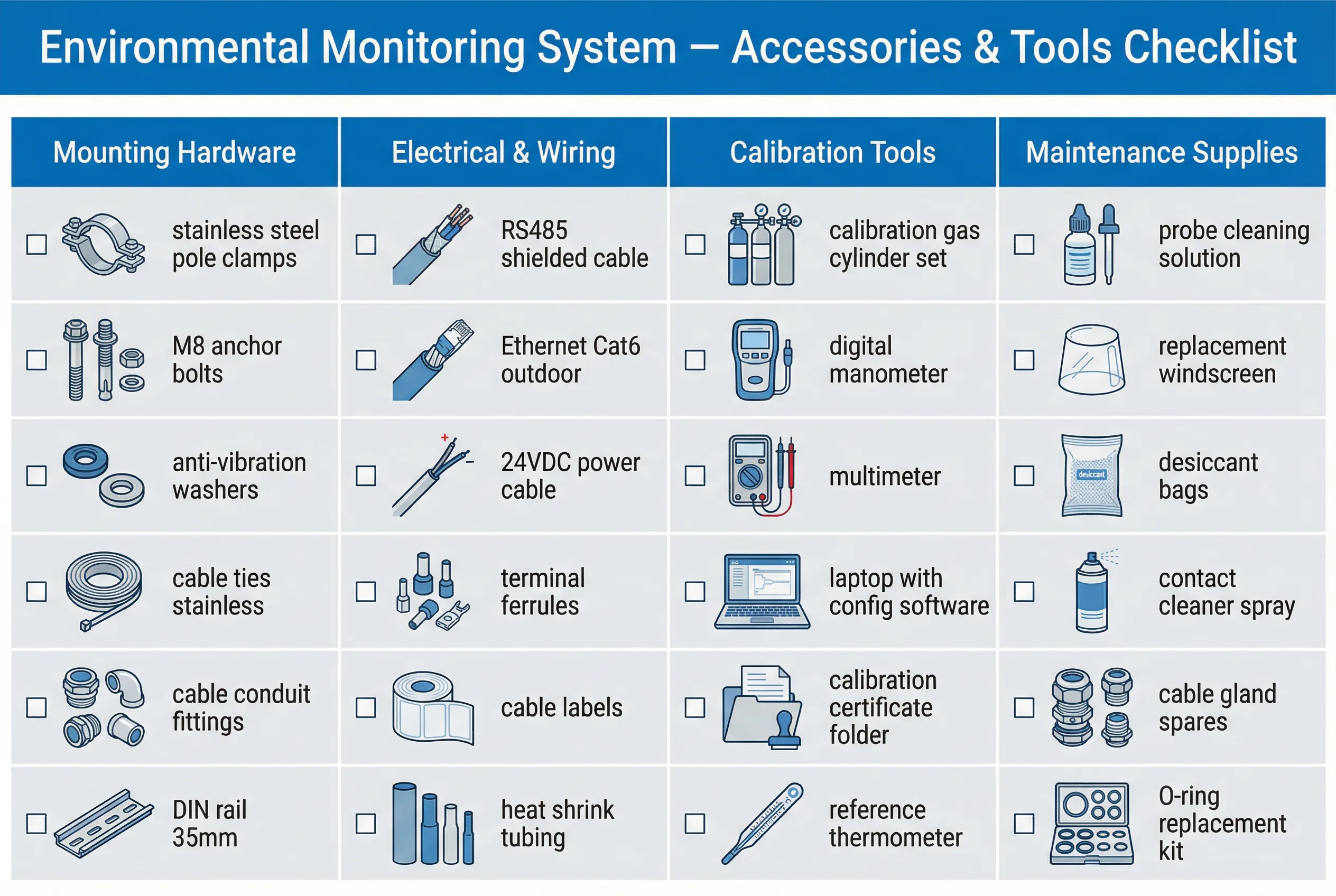
Figure 8.1: Environmental Monitoring System — Accessories & Tools Checklist (Mounting Hardware, Electrical & Wiring, Calibration Tools, Maintenance Supplies)
8.2 Mounting Hardware Specifications
Mounting hardware must be specified to withstand the mechanical loads and environmental conditions of the deployment location. Outdoor installations require stainless steel or hot-dip galvanized hardware to resist corrosion. Pole-mounted equipment must be secured with appropriate clamps that can withstand wind loads without loosening over time. Foundation anchor bolts must be sized for the combined wind and equipment weight loads, with appropriate safety factors for the local wind speed zone.
| Item | Specification | Quantity Guide | Notes |
|---|---|---|---|
| Stainless steel pole clamps | 316 SS, adjustable 60–120mm pole OD, M8 bolts | 2–4 per sensor mounting | Anti-vibration pads recommended for noisy environments |
| M8 anchor bolts | 316 SS, 100mm length, chemical anchor type | 4 per cabinet base | Use chemical anchor in concrete; verify pull-out strength |
| Anti-vibration washers | Neoprene, M8, 3mm thickness | 4 per mounting point | Reduces vibration transmission to noise sensors |
| Stainless steel cable ties | 316 SS, 4.6mm × 300mm, self-locking | 50–100 per station | Use for outdoor cable bundling; UV-resistant |
| Cable conduit fittings | PVC or steel conduit, IP67 fittings, 20–32mm | Per cable run length | Use steel conduit in vandalism-risk areas |
| DIN rail 35mm | Galvanized steel, 35mm × 7.5mm, 1m lengths | Per cabinet size | Cut to length; deburr cut ends |
| Weatherproof cable glands | IP68, metric thread M16/M20/M25, nylon or brass | 2–4 per cabinet | Match gland size to cable OD; torque to specification |
| Monitoring pole | Hot-dip galvanized steel, 3–5m, 60mm OD, base flange | 1 per outdoor station | Concrete foundation required; lightning rod provision |
8.3 Electrical and Wiring Materials
Cable selection is critical for reliable long-term operation. RS485 signal cables must be shielded twisted pair to minimize interference from nearby power cables and electromagnetic sources. Outdoor cables must be rated for UV exposure, temperature extremes, and mechanical protection. All cable ends must be terminated with ferrules to prevent strand breakage and ensure reliable contact in terminal blocks. Cable labeling at both ends is essential for maintenance and troubleshooting.
| Item | Specification | Application | Max Run Length |
|---|---|---|---|
| RS485 shielded cable | 2×0.5mm² twisted pair, overall shield, outdoor UV-rated | RS485 sensor bus | 1200m per segment |
| Ethernet Cat6 outdoor | Cat6 FTP, PE jacket, direct burial rated | Ethernet sensor connections | 100m per segment |
| 24VDC power cable | 2×1.5mm² flexible, PVC jacket, red/black | Sensor power supply | 50m (voltage drop check required) |
| Terminal ferrules | 0.5–2.5mm², insulated, color-coded by wire size | All terminal block connections | N/A |
| Cable labels | Heat-shrink or self-laminating, laser printable | All cable ends | N/A |
| Heat shrink tubing | 2:1 ratio, various sizes 3–25mm, adhesive lined | Cable joint protection | N/A |
| Cable duct | PVC slotted duct, 40×40mm or 60×60mm, DIN rail compatible | Cabinet cable management | N/A |
8.4 Calibration Tools and Standards
Calibration tools must be traceable to national or international measurement standards to ensure that calibration results are legally defensible. NIST-traceable or equivalent calibration certificates must be maintained for all reference standards and calibration equipment. Calibration tools must be stored, handled, and transported according to the manufacturer's instructions to maintain their accuracy. Calibration records must document the tool used, its calibration certificate number, the calibration date, and the results obtained.
| Tool | Specification | Traceability | Calibration Interval | Use |
|---|---|---|---|---|
| Calibration gas cylinder set | Zero gas + span gas for each target analyte; NIST-traceable | NIST / national lab | Per expiry date on cylinder | Gas sensor span calibration |
| Sound level calibrator | Class 1 (IEC 60942); 94 dB and 114 dB at 1 kHz | NIST-traceable | Annual | Noise monitor calibration check |
| Reference thermometer | Platinum RTD; ±0.1°C accuracy; NIST-traceable | NIST-traceable | Annual | Temperature sensor verification |
| pH buffer solutions | pH 4.01, 7.00, 10.01; NIST-traceable; sealed single-use | NIST-traceable | Per expiry date | pH probe calibration |
| Digital multimeter | True RMS; ±0.1% DC voltage; CAT III 600V | Annual calibration | Annual | Voltage, current, resistance measurement |
| Laptop with config software | Windows 10/11; sensor manufacturer software installed | N/A | Software updates as released | Device configuration and diagnostics |
| Calibration certificate folder | Waterproof binder; indexed by device serial number | N/A | N/A | On-site calibration record storage |
8.5 Maintenance Supplies
Maintenance supplies must be stocked in sufficient quantities to support the planned maintenance schedule plus emergency repairs. Critical consumables — such as probe replacement membranes, windscreen covers, and desiccant bags — should be held as on-site spares to minimize downtime when a replacement is needed. Supplier lead times for critical spare parts must be documented and factored into the spare parts inventory level.
| Item | Specification | Replacement Interval | Minimum Stock |
|---|---|---|---|
| Probe cleaning solution | pH-neutral, non-abrasive; manufacturer-approved | Per cleaning visit | 2 liters |
| Replacement windscreen | Foam windscreen for noise monitor; manufacturer OEM | Annual or when damaged | 2 per noise monitor |
| Desiccant bags | Silica gel, 10g, indicating type; for cabinet humidity control | 6 months or when saturated | 10 per cabinet |
| Contact cleaner spray | Isopropanol-based, residue-free, for terminal cleaning | As needed | 2 cans |
| Cable gland spares | Matched to installed gland sizes; IP68 rated | As needed | 2 per size used |
| O-ring replacement kit | NBR or EPDM; matched to probe and cabinet sizes | Annual or when leaking | 1 kit per probe type |
| Replacement DO membrane | Manufacturer OEM; matched to probe model | Monthly to quarterly | 6 per probe |
| Fuse assortment | 5×20mm and 6.3×32mm; 0.5A to 10A range | As needed | 5 of each rating |
8.6 Pre-Mobilization Procurement Checklist
The pre-mobilization checklist ensures that all required accessories and tools are procured and on-site before the installation team mobilizes. Missing items discovered during installation cause delays and additional costs. The checklist should be completed by the project manager at least two weeks before mobilization to allow time for procurement of any missing items.
| Category | Item | Required | Procured | On-Site |
|---|---|---|---|---|
| Mounting | Pole clamps, anchor bolts, anti-vibration washers | Per BOM | ☐ | ☐ |
| Mounting | Cable conduit, glands, DIN rail | Per BOM | ☐ | ☐ |
| Electrical | RS485 cable, Ethernet cable, power cable | Per BOM + 15% spare | ☐ | ☐ |
| Electrical | Terminal ferrules, cable labels, heat shrink | Per BOM | ☐ | ☐ |
| Calibration | Calibration gas cylinders (unexpired) | 1 set per sensor type | ☐ | ☐ |
| Calibration | Sound level calibrator (within calibration) | 1 per project | ☐ | ☐ |
| Calibration | Laptop with all required software installed | 1 per team | ☐ | ☐ |
| Maintenance | Probe cleaning solution, windscreen spares | Per BOM | ☐ | ☐ |
| Maintenance | Desiccant bags, contact cleaner, O-ring kit | Per BOM | ☐ | ☐ |
| Safety | PPE: hard hat, safety vest, safety glasses, gloves | Per person | ☐ | ☐ |